(123) 456-7890
Sign up to receive exclusive UPDATES FROM Modern portable refrigeration
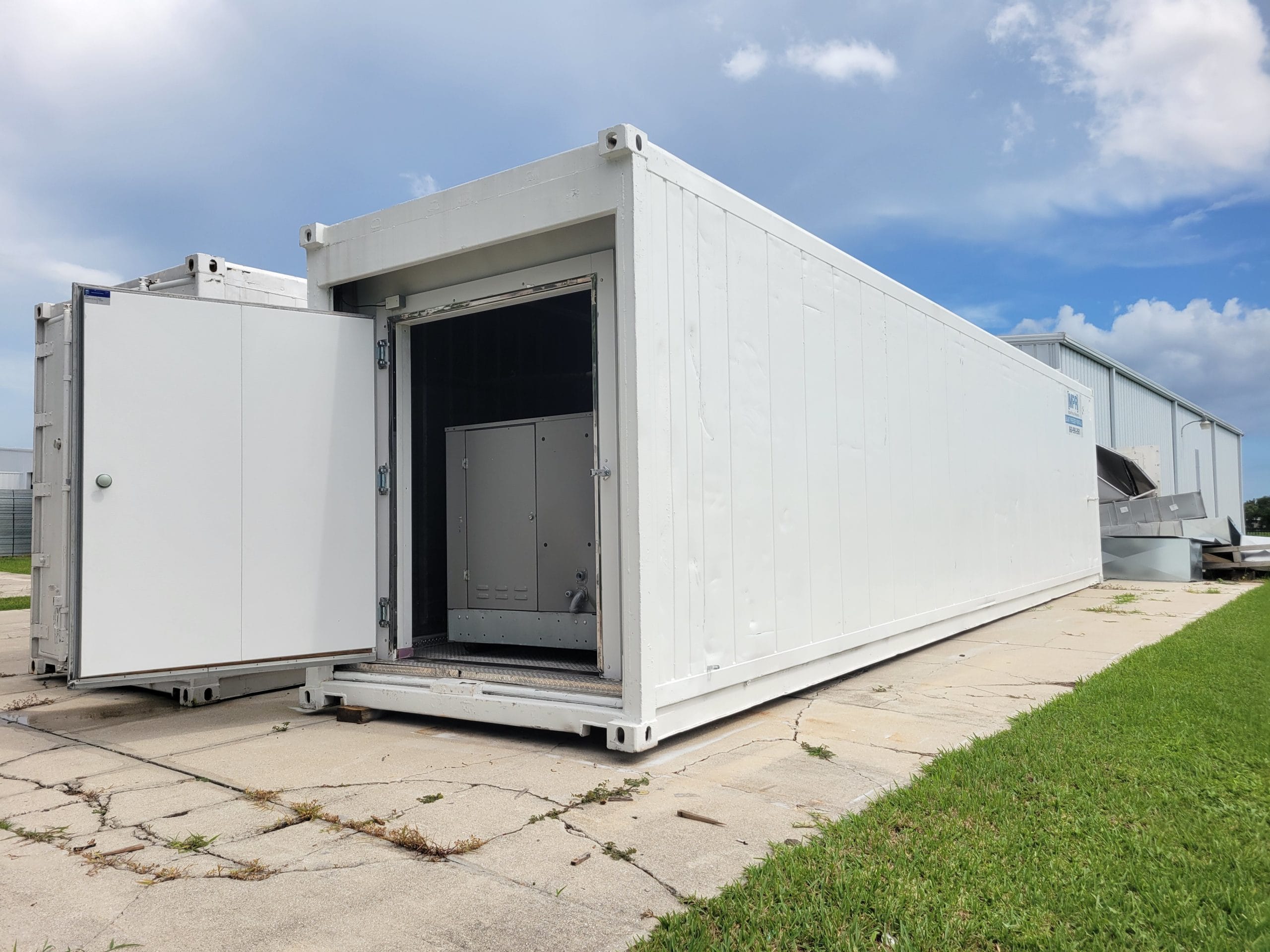
When permanent cold storage isn't available, isn't adequate, or isn't justified, portable cold storage closes the gap. Whether you need refrigerated storage for a seasonal production peak, a facility transition, an emergency, or a remote site, on-site portable cold storage units deliver commercial-grade temperature control without the capital commitment of permanent installation.
Cold storage is a non-negotiable requirement across food production, pharmaceutical distribution, healthcare, agriculture, and event logistics. But permanent cold storage infrastructure- built-in walk-in coolers, refrigerated warehousing, fixed cold chain facilities- is expensive to build, inflexible to relocate, and impossible to deploy quickly when production demands it.
Portable cold storage solutions, mobile refrigerated units, containerized cold storage, and temporary cold storage equipment have changed this calculus for commercial and industrial operations of all sizes. Modern Portable Refrigeration provides portable cold storage units, containerized cold storage, and complete on-site cold chain solutions that deploy in days, scale with production, and operate anywhere with adequate electrical service.
This guide covers the full spectrum of portable cold storage applications, unit types, sizing considerations, and deployment logistics — and explains where portable cold storage fits alongside blast freezing in a complete on-site cold chain.
Related: The Complete Guide to Portable Blast Freezer Rentals — Full ShockFreezer specifications, rental process, and deployment logistics.
| 48 hrs To Deploy From inquiry to operational | 0°F to 55°F Temperature Range Refrigeration to frozen storage | 35 Years Experience Modern Portable Refrigeration |
Portable cold storage refers to self-contained, mobile refrigeration units designed to provide temperature-controlled storage at any location, without requiring permanent installation, facility construction, or fixed infrastructure. These units maintain consistent temperature across a defined temperature range: refrigerated (35°F to 55°F), frozen storage (0°F to -10°F), or deep-frozen (-20°F and below), depending on configuration.
Portable cold storage units are distinct from blast freezers in an important way: blast freezers are active processing equipment; they rapidly reduce product temperature from warm or ambient to frozen. Portable cold storage units are holding equipment; they maintain product that is already at the correct temperature in a stable, controlled environment. In a complete on-site cold chain, blast freezing and cold storage work together: the blast freezer processes product rapidly, and the cold storage unit holds frozen or refrigerated product until shipment or use.
Modern Portable Refrigeration provides both, giving operations the complete on-site cold chain capability that outsourced freezing and third-party cold storage cannot deliver with the same control, speed, or cost efficiency.
Portable refrigerated units maintain product at refrigeration temperatures, typically 33°F to 55°F, for perishable goods that require cold holding without freezing. These units serve the same function as a commercial walk-in cooler but with no permanent installation requirement. Applications include fresh produce holding, refrigerated ingredient storage, pharmaceutical product holding at 2°C to 8°C, and catering cold storage for events and large-scale foodservice production.
Portable freezer units maintain already-frozen product at stable frozen storage temperatures, typically 0°F to -10°F (-18°C to -23°C). These units are cold storage equipment, not blast freezers; they hold frozen product at stable temperatures, not reduce warm product to frozen. They are the right solution for inventory holding, distribution staging, and temporary overflow capacity when existing frozen storage is at capacity.
Containerized cold storage units house complete refrigeration systems in standard ISO shipping containers, 20-foot or 40-foot configurations, providing maximum capacity in a fully weatherproof, self-contained format. Containerized units require only electrical connection and can be positioned outdoors adjacent to any facility, on concrete pads, in dock areas, or at remote production sites. They are transported by standard flatbed truck and positioned by crane or forklift, with no facility modifications required.
For operations requiring both blast freezing and cold storage at a single site, Modern Portable Refrigeration deploys complete mobile cold chain solutions: a ShockFreezer blast freezer unit for rapid product freezing paired with portable cold storage units for holding frozen inventory. This combination replaces the entire cold chain function of a permanent facility for the duration of the rental, providing end-to-end temperature control from raw product to frozen inventory ready for shipment.
The following use cases represent the most common and highest-value deployments for portable and temporary cold storage solutions across commercial and industrial operations.
| Food Processing — Frozen Inventory Overflow Food processors running seasonal production peaks or large contract fulfillment runs frequently exceed the capacity of permanent frozen storage. Portable cold storage units deployed adjacent to the processing facility provide overflow frozen inventory holding without requiring warehouse expansion or third-party cold storage arrangements. Product is blast-frozen on-site with the ShockFreezer and transferred immediately to portable cold storage for holding — the complete on-site cold chain without a permanent facility. |
| Seafood Processing — Dock-Side Cold Chain Seafood operations require continuous cold chain from live product receiving through processing, blast freezing, and frozen inventory holding. Portable cold storage units positioned at the processing dock provide the holding capacity that dock-side operations often lack — allowing blast-frozen product to accumulate in organized frozen storage before pallet-out and shipment, rather than being rushed to third-party cold storage facilities. |
| Pharmaceutical Distribution — Temperature-Controlled Staging Pharmaceutical distributors and 3PL operators handling temperature-sensitive products — vaccines, biologics, clinical trial materials, specialty medications — require validated cold storage at distribution hubs, clinical sites, and staging locations where permanent cold storage is unavailable. Portable refrigerated units with temperature logging and alarm monitoring provide the documented cold chain that pharmaceutical distribution requires. |
| Agricultural Operations — Post-Harvest Holding Produce, dairy, and agricultural operations require refrigerated or frozen storage immediately post-harvest or post-processing at locations where permanent cold storage does not exist. Containerized cold storage units positioned at packing sheds, farm sites, or harvest-adjacent locations provide commercial-grade holding capacity without requiring facility construction. |
| Retail and Foodservice — Seasonal and Event Overflow Grocery retailers, foodservice distributors, and large-scale caterers facing seasonal demand spikes — holiday season, summer peak, large event production — regularly exceed the capacity of existing refrigeration. Portable cold storage units provide temporary overflow capacity during defined peak periods, eliminating the cost of emergency third-party storage and the quality risk of product waiting for cold storage space. |
| Facility Renovation and Transition Operations undergoing facility renovation, expansion, or relocation must maintain cold chain continuity while permanent refrigeration equipment is offline, being relocated, or not yet operational at the new facility. Portable cold storage bridges these gaps — often spanning 3 to 12 months — without interrupting product storage, distribution schedules, or customer commitments. |
| Emergency Refrigeration Storage Equipment failures, power events, and natural disasters that disable permanent cold storage create immediate product risk. Modern Portable Refrigeration maintains a deployment-ready fleet for emergency cold storage deployment — units that can be on-site and operational within 48 to 72 hours to protect inventory, maintain distribution commitments, and bridge the gap while permanent equipment is repaired or replaced. |
| Factor | Portable Cold Storage (Rental) | Permanent Cold Storage Installation |
| Deployment timeline | 48 hours to 2 weeks | 3–18 months (construction + equipment) |
| Capital cost | $0 (rental) | $50,000–$500,000+ depending on size |
| Flexibility | Relocatable — moves with production | Fixed — cannot be moved |
| Scalability | Add units when needed, return when done | Fixed capacity — expansion requires construction |
| Maintenance | Included with rental | In-house or service contract required |
| Facility requirement | Electrical connection only | Construction, permits, insulation, drainage |
| Lease / facility risk | No long-term commitment | Major capital at risk if lease ends |
| Emergency deployment | Yes — fleet maintained for rapid dispatch | Not applicable |
| Temperature documentation | Logging available for compliance | Varies by installation |
Selecting the right portable cold storage unit requires matching unit capacity to your actual holding requirement, accounting for current inventory volume, production throughput, and how long product typically dwells in cold storage before shipment.
| Daily Production Volume | Average Dwell (Days) | Approximate Storage Need | Suggested Configuration |
| Under 2,000 lbs/day | 2–3 days | 4,000–6,000 lbs | Single portable unit |
| 2,000–5,000 lbs/day | 2–3 days | 8,000–15,000 lbs | Mid-size or 20-ft containerized |
| 5,000–10,000 lbs/day | 3–5 days | 25,000–50,000 lbs | 40-ft containerized or multi-unit |
| 10,000–20,000 lbs/day | 3–5 days | 50,000–100,000 lbs | Multi-unit containerized deployment |
| 20,000+ lbs/day | Variable | 100,000+ lbs | Custom configuration — contact MPR |
These are general estimates. Modern Portable Refrigeration conducts a capacity assessment as part of every deployment consultation, translating your specific production data, product type, and operational requirements into an accurate equipment recommendation.
For operations that process fresh or warm product and need to hold frozen inventory on-site, blast freezing and portable cold storage serve distinct but complementary functions, and deploying both eliminates every cold chain dependency on third-party facilities.
| Cold Chain Step | Equipment | Function |
| Rapid temperature reduction | ShockFreezer (blast freezer) | Reduces product from ambient/warm to fully frozen in 90 min–4 hrs |
| Frozen inventory holding | Portable cold storage unit | Maintains frozen product at stable storage temperature (0°F to -10°F) |
| Refrigerated ingredient holding | Portable refrigerated unit | Holds fresh/refrigerated inputs at 33°F–55°F before processing |
| Blast chilling (post-cook) | Mobile blast chiller | Rapidly reduces cooked product to refrigerated temperature before freezing |
| Outbound staging | Portable cold storage unit | Holds palletized frozen product at dock temperature before shipment |
A seafood processor deploying a ShockFreezer for blast freezing and a containerized cold storage unit for inventory holding has, in effect, a complete on-site cold chain facility, deployed in under two weeks, with no capital expenditure, no facility construction, and full operational flexibility to scale or relocate as production demands change.
Temporary cold storage rental serves a distinct need from long-term portable cold storage deployment, covering gaps measured in days to weeks rather than months. Modern Portable Refrigeration's rental fleet supports both timelines.
Equipment failures do not schedule themselves. A refrigeration system failure during peak production season, or a power event that compromises existing cold storage, creates immediate product risk that must be addressed within hours, not days. Modern Portable Refrigeration maintains a deployment-ready fleet for emergency cold storage situations, with expedited dispatch available in most US regions. Temporary cold storage units can be on-site and operational within 48 to 72 hours in emergency scenarios, protecting inventory that a multi-day wait for permanent repair would cost.
Large-scale events, stadium productions, festival catering, and institutional food service events require temporary cold storage capacity for defined production windows. Event cold storage deployments typically run 3 to 14 days, covering pre-production, event-day holding, and post-event inventory management. Portable refrigerated and frozen storage units sized for the event's production volume are deployed, operated, and removed by Modern Portable Refrigeration, with no permanent infrastructure involvement from the operator.
Facility renovations, expansions, and relocations that take permanent refrigeration equipment offline require cold storage continuity for weeks to months. Temporary portable cold storage bridges these gaps, positioned outdoors adjacent to the facility, requiring only electrical connection, and operational throughout the construction timeline without interfering with the building work.
Modern Portable Refrigeration manages the complete deployment process. Here is what the process looks like from inquiry to operational:
Deployment lead time from inquiry to operational is 48 hours to 2 weeks, depending on unit availability, size, and your location. Emergency deployments are expedited.
Modern Portable Refrigeration deploys portable cold storage solutions across the United States and Canada, serving food processing, seafood, pharmaceutical, agricultural, and event applications in all major production and distribution regions.
Need cold storage on-site — fast? Modern Portable Refrigeration provides portable cold storage units, containerized cold storage, temporary cold storage, and complete mobile cold chain solutions across the USA and Canada. Contact us with your temperature requirements, capacity needs, location, and timeline for unit availability and a same-day quote.
© 2026 Modern Portable Refrigeration - All Rights Reserved | Privacy Policy | Accessibility | LLM Info | Website by DigiSphere Marketing

